

Tennessee Car Seat Laws
Tennessee car seat laws set age, weight, and height requirements for rear-facing seats, forward-facing seats, booster seats, and seat belts. After a crash, proper restraint use can also affect the injury claim if an insurance company argues that a child’s injuries were caused or worsened by an improper or missing restraint.
Grissim & Waterman helps families after crashes involving child passengers. We investigate the collision, document restraint use, respond to insurance company blame arguments, and pursue compensation for medical care, pain, and long-term harm.
What Are Tennessee’s Car Seat Laws?
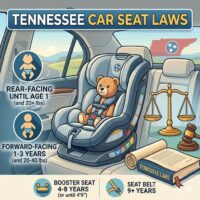
Under T.C.A. 55-9-602, Tennessee’s child passenger restraint law is based on the child’s age, weight, and height. According to the Tennessee Highway Safety Office, the main requirements include:
- Infants under age 1 or weighing 20 pounds or less must ride in a rear-facing child passenger restraint system that meets federal safety standards.
- Children ages 1–3 and weighing more than 20 pounds must ride in a forward-facing child restraint system.
- Children ages 4–8 and shorter than 4’9″ must ride in a belt-positioning booster seat.
- Children ages 9–12 and shorter than 4’9″ must also use a booster seat.
- Children ages 9–12 who are 4’9″ or taller must use a seat belt system.
- Children ages 13–15 must use a passenger restraint system, including a seat belt.
In 1977, Tennessee became the first state to pass a child restraint law, which went into effect in 1978, significantly increasing car seat usage from less than 15 percent at the time. By 1985, all 50 states had adopted mandatory child restraint laws, influenced by Tennessee’s pioneering legislation.
Rear-Facing Car Seat Rules and Children Weighing 20 Pounds or Less
Infants under age 1, or any child weighing 20 pounds or less, must be placed in a child safety restraint system in a rear-facing position, in accordance with federal motor vehicle safety standards and the manufacturer’s instructions accompanying the seat. This should be in a rear vehicle seat when possible.
Some rear-facing seats have a weight limit of up to 50 pounds. In this case, parents and legal guardians can keep the child in this seat until they outgrow it.
Forward-Facing Car Seat Rules
Children between the ages of 1 and 3, or weighing above 20 pounds, must be secured in a child safety seat in the forward-facing position. As before, this should be in the rear seat if possible. Parents should install the seat according to the seat manufacturer’s instructions or the vehicle owner’s manual.
Booster Seat Laws
Children between the ages of 4 and 8, or any child shorter than 4’9″, should be in a belt-positioning booster system until the child’s weight and height exceed the booster seat limitations.
Seat Belt Rules for Child Passengers
A child aged 9 or older, or any child taller than 4’9″, must be secured in safety belts, including a lap belt and shoulder belt. Parents must ensure the child stays seated during the whole trip. If the child has special needs and requires modified child restraints, Tennessee’s child restraint law requires that the doctor’s prescription stay in the car and be provided upon demand.
If a child’s parent or legal guardian is present in the vehicle but not driving, they are responsible for ensuring the child is properly restrained and may also be fined for non-compliance.
Do Children Have to Ride in the Back Seat in Tennessee?
Tennessee law (T.C.A. 55-9-602) requires rear-seat placement for younger children when one is available or when required by the child restraint or vehicle manufacturer’s instructions. For children ages 9–12, sitting in the rear is recommended when available.
What Is the Penalty for Violating TN Child Restraint Laws?
Drivers in Tennessee can be fined up to $50 for failing to properly secure a child in a car seat as required by law. (T.C.A. 55-9-602). Law enforcement officers in Tennessee can stop a vehicle solely for a violation of car seat laws, meaning it is not a secondary violation that requires another reason for the stop.
Can a Car Seat Violation Affect a Car Accident Claim?
Tennessee is not a no-fault state, meaning it uses the modified comparative fault rule. Every party to a lawsuit will share a percentage of blame, and you can only sue if you are less than 50% liable.
In crashes involving child passengers, insurers may consider whether the child was in an age-appropriate child safety seat. While not having the proper seat system will not automatically make you liable, it can become part of the dispute over injury causation, comparative fault, and damages. This may also happen with claims involving airbag injuries to younger passengers, as the injuries may not have occurred if the child had been in the proper seat.
What Should Parents Do With a Car Seat That Compromises Their Child’s Safety in an Accident?
A damaged car seat may not protect a child in a future crash. After an accident:
- Check the manufacturer’s instructions for crash-replacement guidance.
- Look for visible damage, including cracks, bent parts, torn straps, or damaged buckles.
- Do not reuse a damaged or questionable seat.
- Do not throw the seat away if the child was injured or a legal claim may be filed.
- Preserve the seat, base, straps, labels, manuals, and receipts as potential evidence.
- Take photos of the seat, its position in the vehicle, the buckles, the straps, and the vehicle damage.
- Ask an attorney before disposing of the seat if there is any dispute over how the child was injured.
If a defect contributed to the injury or there were no instructions on how to set up the child’s car seat properly, passengers can be compensated for car accident injuries in a product liability claim against the manufacturer or another responsible party. Our Nashville car accident attorneys can investigate and determine if you are eligible for manufacturer compensation.
Where Can Tennessee Parents Check If a Car Seat Meets Child Passenger Safety Requirements?
The State Traffic Safety Office provides Tennessee Child Passenger Safety Fitting Stations, where caregivers can ensure that their car seats are safe and compliant. Additionally, the National Highway Traffic Safety Administration offers recommendations, buying guides, and installation tips to ensure that your child’s car seat is secure.
How Grissim & Waterman Can Help After a Crash Involving a Child Passenger
Our Nashville car accident attorneys help by:
- Investigating the crash and identifying the at-fault driver;
- Preserving photos, vehicle evidence, car seat evidence, surveillance footage, and medical records;
- Reviewing the car seat model, installation, restraint use, and manufacturer instructions;
- Responding to insurance arguments about comparative fault or improper restraint use;
- Identifying claims against negligent drivers, commercial vehicle operators, rideshare companies, manufacturers, or other liable parties;
- Calculating damages for emergency care, follow-up treatment, pain, trauma, disability, and long-term effects;
- Filing a lawsuit before Tennessee’s one-year personal injury deadline if the insurer refuses to resolve the claim fairly.
We offer free consultations and work on a contingency fee basis, alleviating your financial stress during a difficult time. You can speak to a Nashville personal injury attorney from our firm by calling 615-255-9999 or using our contact form.